Pair of Paintings by Italian Artist T Lelli Circa Late 20th Century: appraisal and value basics
Pair of Paintings by Italian Artist T Lelli Circa Late 20th Century research should start with identification, condition, provenance, and recent comparable sales. Use this guide to compare the signals that matter before paying for a formal appraisal or deciding whether to sell.
T. Lelli pair of paintings checklist
Collectors and appraisers increasingly encounter pairs of paintings signed “T. Lelli” attributed to an Italian hand, often dated stylistically to the late 20th century. These pairs commonly feature companion subjects—Venetian canals, Mediterranean harbors, Tuscan farmsteads, or sunlit street scenes—designed to hang together over a sofa or in a hallway. While the precise identity of “T. Lelli” is not firmly documented in standard artist reference books, the name appears frequently in regional auctions and online marketplaces attached to decorative oils from the 1970s–1990s.
This guide explains how to examine, date, authenticate, and value a pair of “T. Lelli” paintings, with practical, market-aware advice for appraisal enthusiasts.
Context: What Collectors Mean by “T. Lelli” and Late-20th-Century Italian Painting
Signature and authorship: Works bearing “T. Lelli” or “T Lelli” typically present as decorative Italian landscapes or cityscapes produced for retail interiors or tourist markets during the later 20th century. There is little published biographical information tying the signature to a single, academically documented artist. In many cases, the signature may represent a workshop or commercial painter producing in quantity.
Subject matter and style: Crisp, picturesque Venetian views tend to dominate, often rendered with palette-knife impasto, warm palette, and a romantic light. Other common motifs include Amalfi coastal views, fishing boats, cypress-lined roads, and market scenes. The compositions are typically balanced in pairs—with related horizon lines and complementary color schemes—which helps them function as interior design sets.
Why pairs matter: A matched pair commands more attention than two unrelated pictures. Symmetry, matching frames, and consistent palette make pairs attractive to decorators and retail buyers. In the secondary market, pairs can sell for a meaningful premium over two single paintings, provided they are closely matched in size, style, and framing.
How to Examine and Date a Pair: Materials, Construction, and Condition
Dating late-20th-century works relies on materials and construction. Consistency across the pair is essential.
Supports and ground
- Canvas and weave: Italian pre-primed canvases from the 1970s–1990s often have a regular machine weave. Look for selvedge edges and factory priming (uniform white ground). Stretcher stamps or pencil markings can occasionally note size in centimeters.
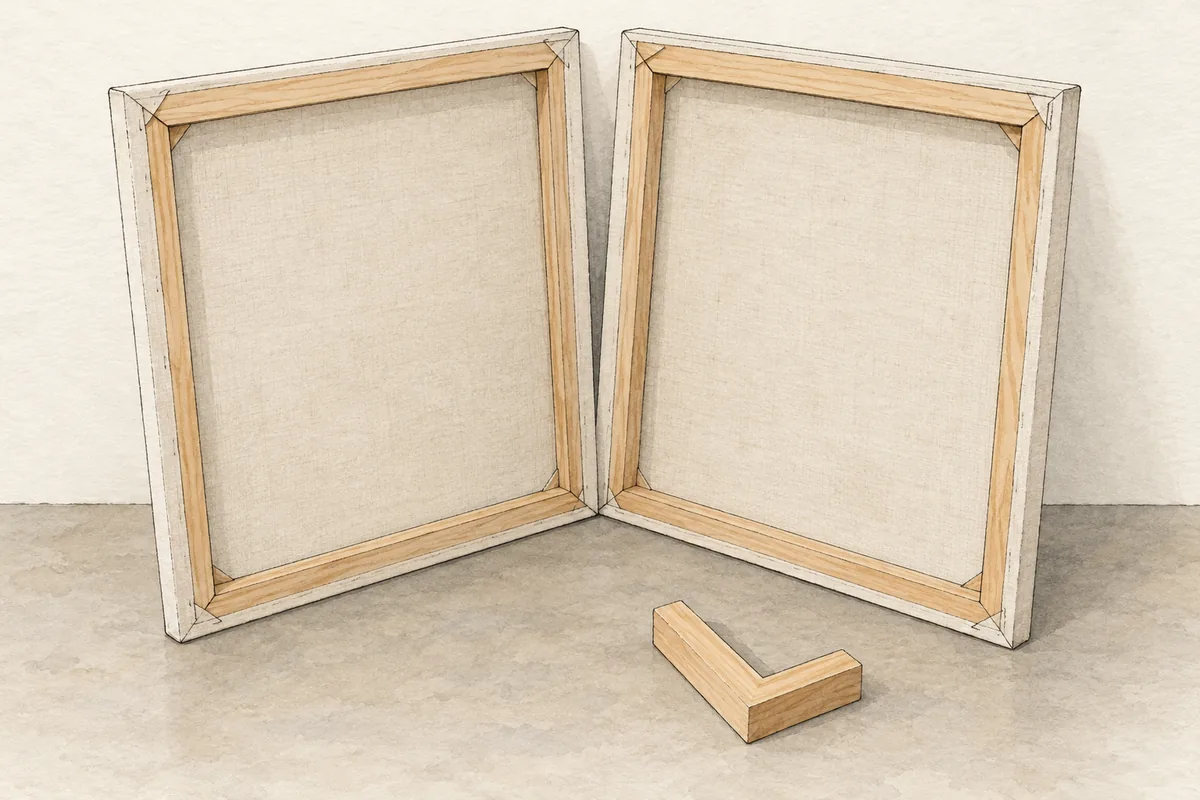
- Staples vs. tacks: Staples on the stretcher’s reverse are normal for this period; older 19th/early 20th works tend to use tacks. Winged metal keys (wedges) in stretcher corners are standard; missing or loose keys contribute to slack canvas.
- Panel supports: Some late 20th-century decorative works appear on prepared board or composite panel. Check edges for factory cuts and fiberboard layers.
Medium and surface
- Oil vs. acrylic: Both are possible. Under raking light, oil impasto often sits with rounded peaks; acrylic can be slightly rubbery with broader, softer ridges. A faint linseed scent may linger in oils. A reversible, slightly glossy varnish is common on oils; acrylics may be unvarnished or have a matte acrylic varnish.
- Varnish: Even, glossy varnish that fluoresces weakly under UV can suggest a synthetic varnish typical of late 20th century. Patchy fluorescence might indicate retouching.
Signatures and inscriptions
- Execution: A hand-painted signature at lower right or lower left is typical. Look for the signature to sit atop dried paint/varnish, exhibiting proper cracking and aging congruent with the rest of the surface. Compare both paintings: angle, brush weight, and pigment of the signature should be similar.
- Labels: Retail gallery labels (“Made in Italy,” size stickers in cm, or boutique framers’ labels from Italy or abroad) help support a late-20th-century origin. Keep any original receipts or export labels.
Frames and hardware
- Frame styles: Gilt or antiqued-composite frames with linen liners (cream or ecru) are classic 1970s–1990s choices. Matching frame profiles and liners are crucial to preserving the pair’s value.
- Backing: Dust covers (brown craft paper), foam-core backers, and staple-mounted hangers (sawtooth or wire) are all consistent with the period.
Condition points that matter
- Surface soil and nicotine haze: Common in domestic settings; often removable by a conservator with surface cleaning.
- Varnish discoloration: Slight ambering is normal; heavy yellowing may warrant professional cleaning.
- Edge wear and stretcher bar impressions: Common in unlined canvases. Minor impressions are acceptable; deep creases detract.
- Abrasion and losses: Palette-knife impasto can chip at peaks; losses along frame rabbet lines appear as white lines along edges.
- Frame integrity: Loose corners, liner discoloration, or flaking composition reduces presentation value. Original matching frames are valuable even if they need minor repair.
When the materials, signature execution, and frames between the two works line up closely, the pair reads stronger and sells better.
Signatures, Attribution, and Avoiding Reproductions
Because “T. Lelli” is not a firmly established, widely documented studio artist in reference literature, attribution is primarily to a named commercial hand rather than a catalogued oeuvre. That makes careful scrutiny of the surface and signature even more important.
Signature variants: Expect “T. Lelli,” “T Lelli,” or “T. LELLI” in block or cursive. Compare letterforms between the two paintings: a consistent “T” stem and crossbar, similarly spaced double “l,” and matching period placement are good signs.
Painted vs. printed: Ensure the signature is in paint with discernible brushstrokes or pen pressure. On some reproductions, signatures are printed into the image; under magnification, you’ll see dot patterns or uniform ink absorption inconsistent with hand paint.
Workshop repetition: Repeated compositions (the same gondola angle, same two boats, same balcony) across multiple “T. Lelli” works on the market can indicate a pattern-based studio production. This doesn’t necessarily negate authenticity as a hand-painted object, but it frames the work as decorative rather than unique fine art.
Distinguishing oil on canvas from prints on canvas
- Texture: True impasto casts shadows and has irregular height; canvas transfers/prints have uniform texture with no displaced paint.
- Edge paint: Check the edges under the frame lip—hand-painted works show stray brushstrokes and color carry-over; canvas prints usually have a clean edge and sometimes a glossy coating with no color wrap.
- UV light: Printed images often show flat, even fluorescence or none; retouched prints show bright spots where new paint was applied.
Provenance and documentation: Any gallery invoice, certificate from a retail gallery, or import note from the 1970s–1990s supports period origin. Note that a gallery COA attests to sale, not necessarily to a specific biography.
If you suspect a reproduction (including textured prints made to mimic impasto), consult a conservator or dealer. A quick in-person look typically settles the question.
Market and Valuation: Comparable Sales and Price Drivers
Without an established academic biography, the market for “T. Lelli” skews to decorative and regional auction contexts. Value depends on subject matter, size, condition, and the strength of the pair.
Subject premiums
- Venetian canals with architectural detail, reflections, and gondoliers generally lead the category.
- Sparkling harbor scenes with boats and sunlit facades rank next.
- Generic countrysides or still lifes tend to achieve lower prices than named-city views.
Size and presence
- Mid-size (approximately 40–60 cm on the long side) is typical. Larger, room-dominant canvases can bring a premium if the quality holds.
- Heavy, well-made matching frames enhance perceived value, particularly in retail or decorator channels.
Condition and match
- Clean surfaces, intact impasto, and no repairs are ideal. Matched frames and consistent palette between the two works preserve the pair’s integrity.
- Mismatched frames or substantial condition disparity between the two reduces pair value; consider offering them individually in that case.
Where they sell and typical ranges
- Regional auctions and generalist houses: Late-20th-century Italian decorative oils of this type often realize modest to mid-three-figure results per painting, with pairs fetching a combined low-to-mid four figures when subject matter and condition are strong.
- Online marketplaces: Realized prices can be volatile; presentation and photography matter. Expect broader ranges and buyer sensitivity to shipping costs.
- Retail galleries and design trade: Pairs can command higher ask prices for framed, ready-to-hang sets, reflecting curation, overhead, and warranty.
Because realized prices vary with presentation, local demand, and venue, base any appraisal on fresh comparable sales. Search for:
- Recent results for “T. Lelli” or “Italian school, signed Lelli”
- Similar subject (e.g., “Venetian canal,” “Mediterranean harbor”)
- Comparable size, impasto quality, and frame type
- Sales within the last 24–36 months
If your pair has superior detail, rich impasto, matching gilt frames with linen liners, and crisp, atmospheric lighting, expect it to sit toward the higher end of decorative comparables. If condition issues or mismatched elements are present, adjust downward.
Practical Checklist
- Confirm medium: Under raking light, verify hand-applied impasto; rule out printed texture.
- Compare the pair: Match canvas type, stretcher construction, palette, and framing.
- Inspect signatures: Painted, not printed; similar hand across both works.
- Document labels: Photograph any gallery/framer stickers, size stamps, or “Made in Italy” tags.
- Assess condition: Note varnish haze, surface dirt, edge wear, and frame integrity.
- Clean prudently: If dirty, consult a conservator for surface cleaning; avoid DIY solvents.
- Photograph properly: Natural light, straight-on, detail shots of signatures and backs.
- Research comps: Use recent sales for similar subject/size; adjust for condition and pairing.
- Decide venue: Pair sells best as a matched set in decorator-friendly channels; single out only if mismatched.
- Preserve frames: Matching original frames are part of the value proposition.
FAQ
Q: Is “T. Lelli” a listed, academically documented artist? A: The signature “T. Lelli” appears widely on decorative Italian oils from the late 20th century, but there is limited biographical documentation in standard artist dictionaries. Appraise primarily on the quality, condition, subject, and market comparables rather than on a blue-chip artist premium.
Q: Are these typically oil or acrylic? A: Both occur, but many examples are oil on canvas with palette-knife impasto and a glossy synthetic varnish. Confirm under raking light and magnification. Acrylic surfaces often look more matte with softer ridges.
Q: Does selling as a pair always increase value? A: Usually. Buyers value symmetry and matching frames. A well-matched pair can bring a premium over two singles. If one painting is notably inferior in condition or execution—or the frames are mismatched—you may net more by selling individually.
Q: Should I reline or revarnish before selling? A: For late-20th-century works, relining is rarely necessary. Light professional surface cleaning and minor varnish adjustment can significantly improve presentation. Avoid heavy interventions that outstrip likely market return.
Q: What’s the biggest pitfall to avoid? A: Confusing textured reproductions for hand-painted oils. Verify true impasto, examine the signature as paint, and check edges under the frame. When in doubt, seek an in-person opinion from a conservator or dealer.
By approaching a “T. Lelli” pair methodically—verifying materials, ensuring the pair matches, documenting labels and condition, and grounding expectations in recent comparable sales—you can arrive at a confident, market-aligned appraisal and position the paintings for a successful sale or informed acquisition.


