After Ludwig Gschossmann Ballroom Scene Painting: appraisal and value basics
After Ludwig Gschossmann Ballroom Scene Painting research should start with identification, condition, provenance, and item-specific market evidence. Use this guide to compare the signals that matter before paying for a formal appraisal or deciding whether to sell.
After Ludwig Gschossmann Ballroom Scene Painting Value Guide
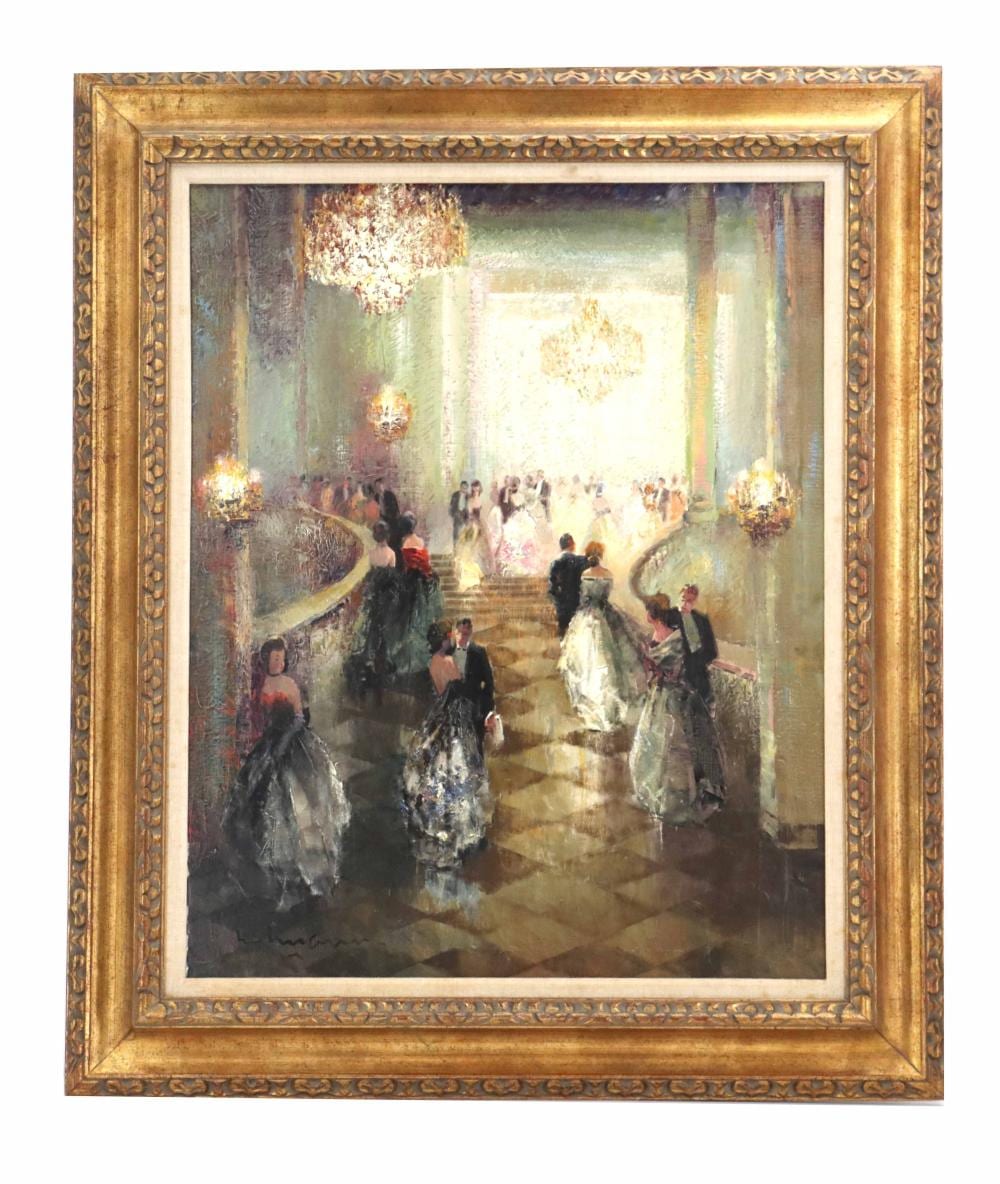
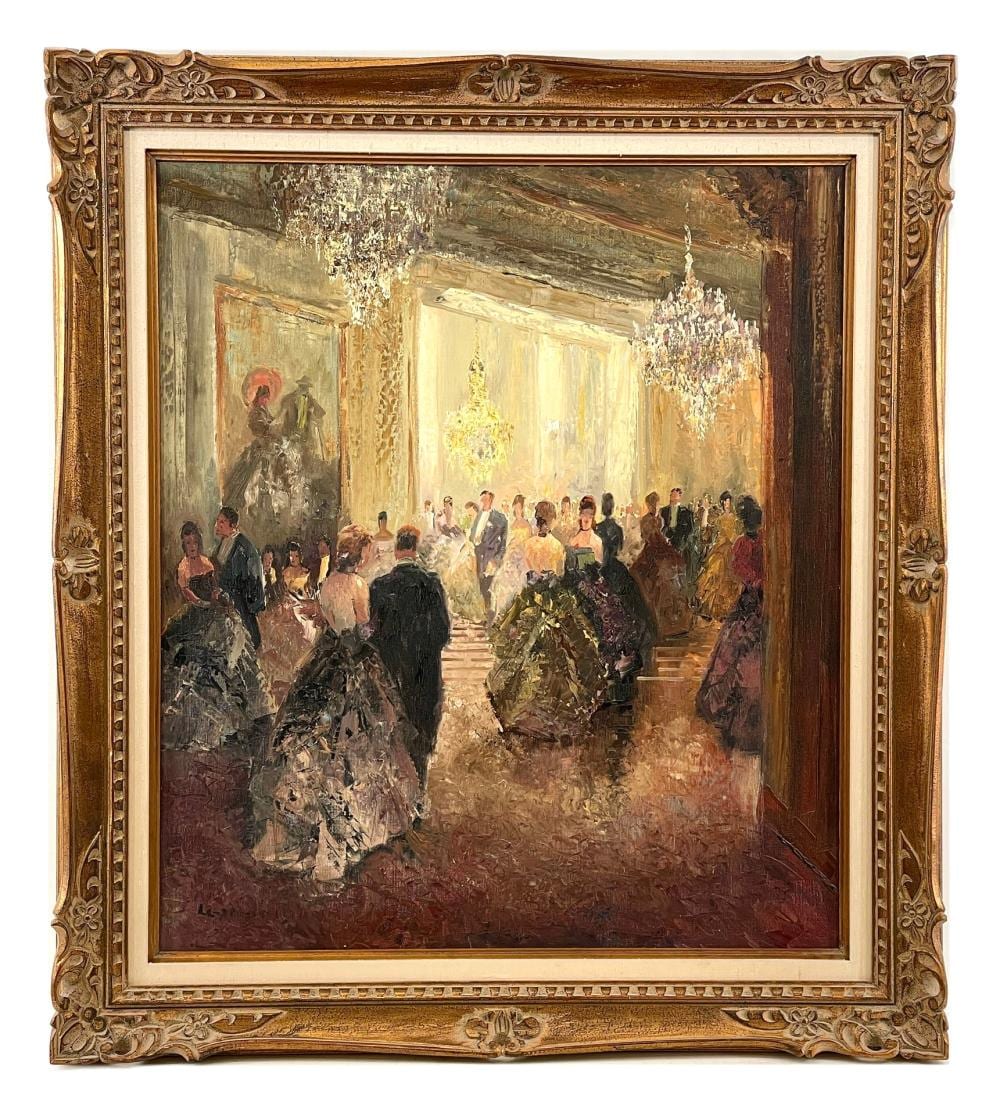
Paintings labeled “After Ludwig Gschossmann” appear frequently in auction catalogues and estate inventories, especially those depicting glittering ballrooms with chandeliers, waltzing couples, and Belle Époque finery. For appraisers and collectors, distinguishing an autograph work by Gschossmann from a later copy, workshop picture, or commercial reproduction can have significant implications for value. This guide clarifies what “after” means in art-market practice, outlines the hallmarks of Gschossmann’s ballroom compositions, and provides a practical workflow for inspection, documentation, and valuation.
Who Was Ludwig Gschossmann and Why the Ballroom?
Ludwig (often “Louis”) Gschossmann was a 20th‑century painter associated with Munich circles and the broader tradition sometimes grouped under the “Munich School.” He is best known for polished genre scenes—opulent interiors, promenades, and especially ballroom scenes filled with elegantly dressed figures and theatrical lighting. His work appealed to dealers and collectors who favored romantic historicism, and the enduring popularity of these subjects led to repeated compositions, studio variants, and numerous copies by later hands.
Ballroom scenes attributed to Gschossmann typically present:
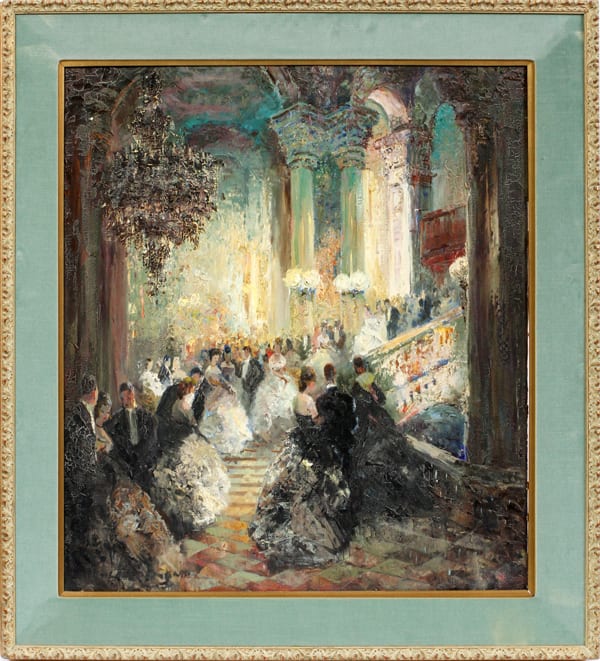
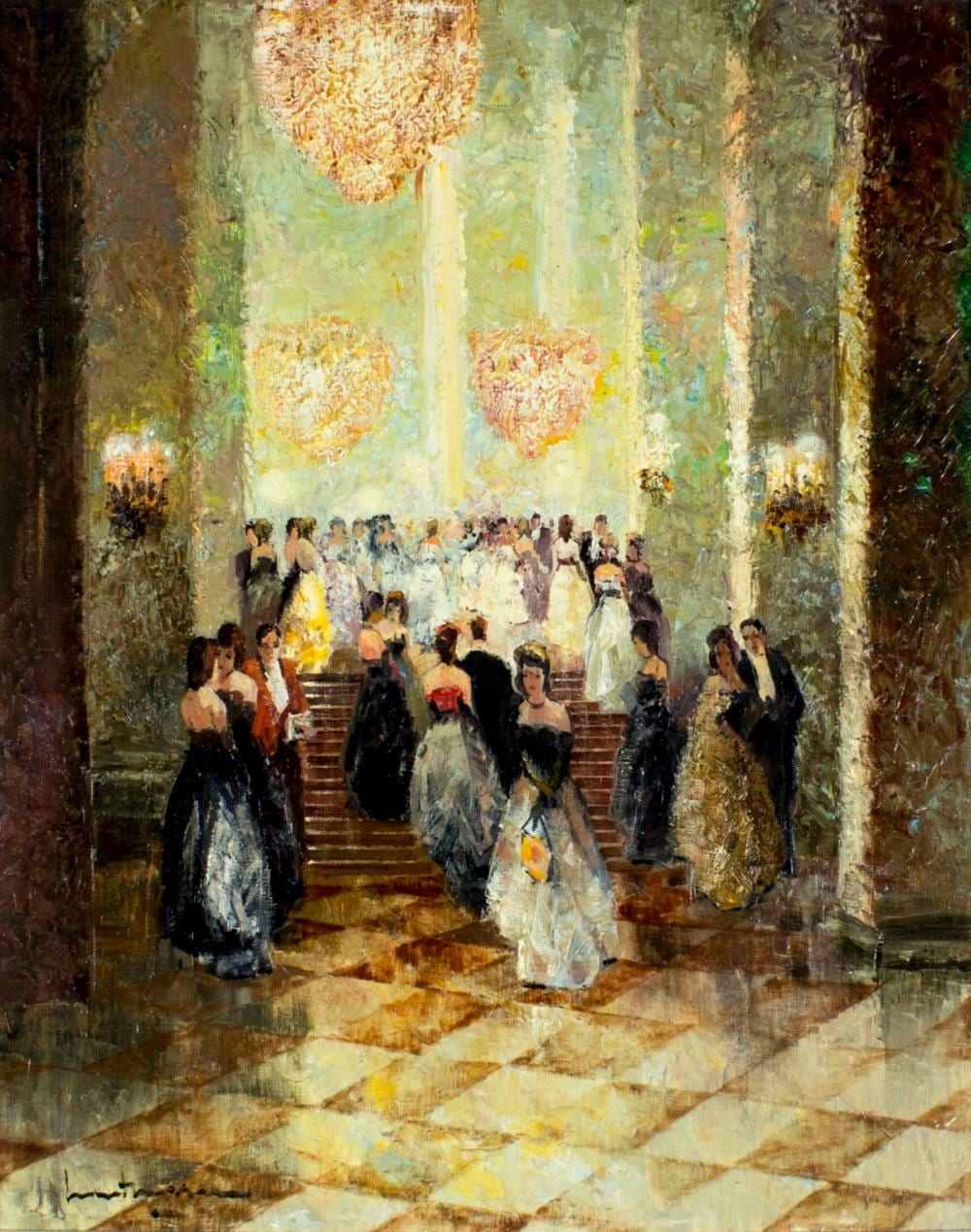
- A grand interior with high ceilings, crystal chandeliers, balconies, and columns.
- Couples in formal attire—women in pastel gowns with sheen; men in black tails and white tie.
- Warm, golden tonalities with rose and cream highlights; reflective parquet floors.
- A composition that guides the eye across a crowded hall to a central dancing couple or a luminous chandelier.
These characteristics made his images prime models for copiers, decorators, and commercial ateliers. Thus, many “ballroom” canvases encountered today are either studio variants or later works “after” a known Gschossmann composition.
What “After” Means on the Art Market
Auction houses and appraisers use a hierarchy of attribution terms. While practice varies slightly by region, the following provides a reliable framework:
- By Ludwig Gschossmann: The work is, in the opinion of the cataloguer, an original by the artist.
- Attributed to: Probably by the artist, but with some uncertainty.
- Studio of/Workshop of: Made in the artist’s studio, possibly under his supervision, but not necessarily by his hand alone.
- Circle of: Made by a contemporary closely associated with the artist or school.
- Follower of: Made in the artist’s style, possibly later.
- Manner of: In the style of the artist, but not by the artist; often later.
- After: A copy of a known work by the artist, executed by another hand; usually later.
“After Ludwig Gschossmann” therefore signals a copy or re‑creation of a known Gschossmann composition. It may be faithful in layout and color, or it may introduce small deviations, but it is not considered autograph. In some cases, “after” appears as an inscription by a seller or dealer on the verso; in others, an auctioneer assigns “after” in the catalogue to clarify the work’s status.
Value implication: “After” pieces typically carry significantly lower estimates than autograph works. The degree of discount depends on quality, age, medium, condition, and market appetite for decorative genre paintings in the given region.
Visual Traits of Gschossmann Ballroom Scenes
When evaluating a ballroom scene labeled or suspected to be “after” Gschossmann, compare observed features with their expected counterparts in artist‑authored works. The following traits are commonly encountered in better‑quality originals and high‑grade studio variants:
Composition and staging:
- Central or near‑central dancing couple framed by a semi‑circle of observing figures.
- Light axis from chandeliers or candelabra, creating a temporal “spotlight” on satin gowns and faces.
- Strong perspective cues—receding lines of parquetry, colonnades, or balcony rails.
- Secondary groupings: musicians to one side, seated figures along the walls, servants or ushers near doorways.
Color and light:
- Warm golden illumination; highlights tipped with pale yellow or cream.
- Dresses in rose, peach, ivory, pale blue; subtle color harmony rather than high chroma contrast.
- Men’s black tails rendered with nuanced greys and reflected floor light, not flat black.
- Parquet reflections articulated with thin, semi‑transparent glazes, not opaque streaks.
Brushwork and surface:
- Faces and hands: controlled, economical strokes; features suggested rather than meticulously delineated.
- Chandeliers: small, bright impasto flecks for crystal sparkle; delicate metal arms with confident line.
- Gowns: layered brushwork giving the impression of sheen and weight; hems set off with highlights and soft shadows.
- Overall, a balance of smooth passages and selective impasto; refined, not overly slick.
Repetitions and variants:
- Gschossmann—and later followers—reused successful ballroom layouts. Expect to see near‑identical arrangements across multiple canvases, sometimes mirrored or slightly re‑colored.
- Higher‑quality originals often show more convincing anatomy, nuanced facial groupings, and richer glazing; later copies can look flatter, with overly symmetrical crowd placement and less atmospheric depth.
Warning signs of a later “after” copy:
- Uniform, glossy varnish with little modulation; surfaces that “read” as new despite claimed age.
- Faces rendered with excessive detail or cartoonish outlines, out of keeping with the refined brevity of better examples.
- Chandelier crystals depicted as repetitive dots without variation in value.
- Dead zones in the crowd where figures lack proportional coherence or cast shadows.
Signatures, Inscriptions, and Labels to Expect
Signatures:
- Common forms: “L. Gschossmann,” “L. A. Gschossmann,” “Ludwig Gschossmann,” and occasionally “Louis Gschossmann” for works intended for French‑speaking markets.
- Placement is typically lower right or lower left, small and integrated with the paint layer. Script tends to be tidy and slightly inclined, not flamboyant.
- Be cautious with thick, fresh‑looking signatures sitting atop aged varnish or cracking; under magnification, a genuine signature should be embedded in the original paint/varnish sequence, not sitting as a late addition.
Verso markings:
- Period stretchers may bear label remnants from European dealers, inventory numbers, or title notations. Later “after” works sometimes include “after L. Gschossmann” on the back; however, many do not.
- Factory canvas stamps on modern reproductions (20th century) can appear on the verso; note any brand stamps or export stickers.
Other indicators:
- Frames: Original or period‑appropriate ornate gilt frames are common. However, frames are frequently swapped in the trade; they cannot document a work on their own.
- Certificates: “Certificates” accompanying decorative copies are often modern and non‑authoritative. Weigh them cautiously.
Pro tip: Compare letterforms of the signature across verified examples. Focus on the formation of the initial “G,” the spacing between characters, and the angle of the long descender in “g.” Forged signatures often fail in rhythm and paint integration.
Materials, Age Indicators, and Condition Red Flags
Supports and grounds:
- Originals and period studio works are typically oil on canvas with a warm ground. Expect European, medium‑to‑fine weave canvases; common sizes range roughly from 40 × 50 cm to 60 × 80 cm, with larger examples existing.
- Many “after” pieces are also oil on canvas, sometimes on modern machine‑made stretchers or relined. Decorative reproductions may be oil on board or oil‑type paints on canvas board.
Stretchers and fixings:
- Traditional keyed stretchers with mitred, beveled members are consistent with European practice. Nails along the tacking edge can suggest age; staples indicate later stretching (though relining can also introduce staples).
- Look for shrinkage cracks at keys, oxidation on tacks, and appropriate handling wear.
Paint film and varnish:
- Natural resin varnishes can yellow; look for differential cleaning, abrasion on high points, and craquelure consistent with canvas movement.
- UV inspection: Natural resins fluoresce greenish; newer retouches appear dark. A signature that quenches UV while surrounding varnish glows can indicate a later addition.
- IR/infrared reflectography: While not all genre paintings show underdrawing, pentimenti (subtle compositional changes) can support originality; exact tracing of known compositions without change can suggest copying.
Common condition issues:
- Abrasion in darker suit passages; overcleaning on facial highlights.
- Overpaint in chandelier areas to “brighten” crystals; sometimes done unsympathetically.
- Relining and restretching that compress impasto and alter surface character.
Red flags for modern decorative copies:
- Perfectly even age‑craquelure or artificial cracking patterns.
- Spray‑applied, high‑gloss varnish sitting in a continuous layer across paint and later frame touch‑ups.
- Odor of fresh varnish or solvents inconsistent with purported age.
Market Values: Originals vs. After Works
Values fluctuate by region, season, and overall demand for romantic genre painting. As a general orientation:
- Documented autograph ballroom scenes by Gschossmann can attract competitive bidding, with realized prices often in the low to mid four figures and, for larger, particularly accomplished works, into the low five figures. Quality, size, and condition are decisive.
- “Studio of” or convincingly period workshop pieces typically bring lower sums than autograph works but can still sell well when decorative appeal is high.
- “After Ludwig Gschossmann” copies—especially later 20th‑century decorative oils—tend to realize modest prices, often in the low hundreds to low thousands depending on size, frame, and decorative impact.
For formal appraisals, support any value conclusions with recent, market evidence of similarly attributed ballroom scenes, adjusted for size, condition, and quality. Avoid anchoring to outlier results.
Appraisal Workflow and Documentation
A disciplined process helps avoid misattribution and supports defendable values:
Initial intake
- Record dimensions (sight and overall with frame), medium, and support.
- Photograph recto and verso in diffuse light; detail the signature and key passages (faces, chandelier, parquet reflections).
Stylistic analysis
- Compare composition, palette, and brushwork with documented Gschossmann ballroom examples.
- Identify reused motifs: dress shapes, balustrades, chandelier forms, and crowd geometry.
Technical examination
- Magnification: Assess signature integration, craquelure, and paint layering.
- UV light: Map retouches, overpaint, and varnish pattern.
- If warranted, IR imaging and X‑ray can reveal tracing or pentimenti.
Inscriptions and provenance
- Transcribe all inscriptions and labels; note language, handwriting characteristics, and paper aging.
- Gather ownership history, purchase receipts, or gallery invoices; weigh their credibility.
Attribution decision
- Assign status using the accepted terminology: by, attributed to, studio of, manner of, after.
- Clearly justify “after” when evidence suggests a copy of a known composition by another hand.
Condition reporting
- Note structural issues (tears, relining, deformations) and cosmetic matters (abrasion, discoloration).
- Estimate conservation needs and costs if relevant to fair market value.
Valuation
- Build a market-evidence set segmented by attribution category and size.
- Adjust for condition, quality, and region; present a range with a reasoned midpoint.
Reporting
- Provide a narrative summary, images, and methodology; cite sources of market evidence.
- State assumptions and limitations, including the scope of technical analysis performed.
Practical Checklist
- Confirm the attribution category: is it explicitly catalogued “after,” or is the label inferred?
- Examine signature under magnification and UV; assess paint integration and aging.
- Evaluate hallmark compositional cues: chandelier handling, parquet reflections, facial brevity.
- Inspect support and stretcher: keyed vs. fixed, nails vs. staples, relining evidence.
- Document verso: labels, stamps, inventory numbers, and any “after” notations.
- Map condition issues and overpaint; note conservation history or needs.
- Build market market evidence for similarly sized and attributed ballroom scenes.
- Draft a clear, defendable conclusion with images and reasoning.
FAQ
Q: Does “after Ludwig Gschossmann” always mean the painting is a forgery? A: No. “After” denotes a copy of a known composition by another hand, which can be historical, decorative, or workshop‑related. It is not presented as a deceptive forgery when catalogued transparently; it is simply not autograph.
Q: Are there prints or chromolithographs of Gschossmann’s ballroom scenes? A: Reproductive prints and later oil‑type reproductions exist. Always check medium (true oil on canvas versus print on board), surface texture, and margins/verso for print indicators or factory markings.
Q: Where is the signature usually located, and how reliable is it? A: Typically lower right or left. Signatures can be forged or added; assess with magnification and UV to determine whether it is contemporaneous with the paint layer and consistent with known letterforms.
Q: What sizes are most common, and does size affect value? A: Mid‑sized canvases around 40 × 50 cm to 60 × 80 cm are common, with both smaller panels and larger showpieces existing. All else equal, larger, well‑painted examples tend to command higher prices, but quality and condition trump size.
Q: How much less is an “after” work worth than an original? A: It varies widely. Decorative “after” works often realize a fraction of autograph prices—commonly the low hundreds to low thousands versus low four to low five figures for strong originals—subject to quality, region, and market conditions.
In sum, successfully appraising an “After Ludwig Gschossmann” ballroom scene means combining stylistic sensitivity with technical scrutiny and market awareness. Transparent attribution, thorough documentation, and carefully selected comparables will yield the most credible result.